
I’m always amazed at the range of experiences I read about in the Flash Prose Contest. Special thanks to the judges and to each of you who took courage in hand and submitted your work. We’re happy to read your pieces in any contest, so don’t hesitate to enter again. Thanks for sharing.
First Place:
The Granny Nanny
By Carol Beltrand

My phone rang straight away. Surprisingly, it was a private secretary rather than a parent on the line. Perhaps my accent put her in mind of Mary Poppins because she offered me the position on the spot. The job paid exceptionally well and started immediately.
“Ah, how many children…”
She interrupted my question with a nervous laugh, saying “Great! See you in an hour!”
I felt a bit rushed but decided to give it a go anyway, never imagining what awaited me.
Let me explain. I don’t have children. Motherhood wasn’t my cup of tea: all nappies, emotional entanglements, passing on of one’s faults. Unfortunately, not being a mother necessarily disqualified me from being a grandmother.
My solution: I placed an advert. “Work Wanted, Granny Nanny.” I fancied enjoying the perks of grannyhood – reading bedtime stories, receiving sticky kisses and soft hugs – without the usual mother/child complications.
I arrived promptly; my eyes widened as a uniformed doorman ushered me to a private lift. My reflection in the mirrored elevator caused my spirits to drop; I wasn’t dressed for looking after privileged children in elegant surroundings. Mind you, I’m not dowdy. I simply dress for comfort. Even my pockets, filled with sweeties for the little ones, drooped a bit.
When the elevator opened I was greeted by a smartly dressed secretary pressing a cellphone tightly to her ear. She half-whispered, “She’s here!” into the phone before snapping it shut, then flashed me a smile.
“Welcome, Irene! Follow me, please. I’ll introduce you to her now.” She led me down a hallway, high heels click-clicking along the marble floor.
“The salary suggested I’d be in charge of more than one?”
She ignored my question. “I’m afraid she may not be happy about the arrangement.”
“They seldom are,” I replied, trying to sound experienced.
The view of Central Park from the two-story livingroom windows was so distracting I missed seeing the tall, slender woman standing nearby.
“Irene, this is Dame.”
Dame wore an expensive dress of lavender chiffon. Her perky face suggested that in her day she’d been cute rather than beautiful. It also suggested she was at least eighty years old.
“You aren’t needed,” Dame said, with a toss of her perfectly coiffed head.
“You prefer looking after your granddaughter alone?” I ventured, ignoring her ill-mannered decree.
Dame pursed her lips, smearing her overly-bright lipstick. “What do you mean? I don’t have grandchildren. My meddlesome lawyer thinks I need a minder. If I did, a handsome young man might do. Certainly not a plain, middle-aged woman. Go!” She waved me away with a bejeweled hand.
That explained everything; they’d misinterpreted my advert. I couldn’t wait to leave.
Oddly, Dame then came closer. I had to tip my head back slightly to meet her defiant stare. “I was five-eleven,” she boasted, “I’m shorter now, but I can still dance.” She flashed a ballet slipper from beneath her chiffon hem. I gave her a tepid smile.
The frustrated secretary escorted me out. I paused to admired the dozens of photographs of Hollywood celebrities of the ‘40s and ‘50s lining the hallway. I recognized the actors but not the chorus girls, young women posed arm-in-arm, plumed headdresses held high, smiles dancing across their faces. Everyone looked delightfully chummy. I felt a presence over my shoulder. Dame had followed.
“That’s me in the chorus, second from the left.” She leaned in, pointing to a photograph. “And that’s me with my late husband, next to Fred Astaire. I danced with Astaire once. His co-star was late for rehearsal. He said I moved divinely.”
Suddenly, like a little girl showing off for her mum, Dame raised up on tiptoe and twirled. The secretary froze. Dame faltered. I rushed forward, arms outthrust, catching and guiding her upright. Holding her was like hugging a feather.
“What a lovely dip.”
My compliment worked; Dame’s dignity remained intact. We linked arms and returned to the livingroom, settling side by side on a plush sofa.
“Sweetie?” I asked, reaching into my pocket.
“Oh, I adored these as a child.” She’d forgotten having rudely dismissed me. “I’ll ring for tea, if you’re in no rush.”
The salary was exceptional, the penthouse was luxurious, and despite her protests, Dame clearly needed a minder. She was irksome, but not intolerable. I reconsidered the position.
“Yes,” I replied, “Tea would be lovely.”
“Gin or vodka?”
I smiled. This was getting fun.
“Gin, if it’s no bother. Tell me, why do they call you Dame?”
@@@
Carol Beltrand’s work has appeared in Sagewoman and New City Neighbors Magazines. She’s written novels, short stories, to-do lists, travel logs and journals. Having spent the past several years devoted to writing long form fiction, she pivoted. This is her first Flash Fiction Contest.
Second Place:
All of It Is Yours
By Nathan Mann

In the contract was a promise: clear the land in a month and all of it is yours. He had tried everything else, so he bought a machete, signed the paper, and found the lot deep within the marsh.
He got out of his truck and tested the ground with his boot. Still wet. Spring was becoming summer though, soon the land would firm.
Half the lot was covered in tall, golden reeds. Last year’s growth. He swung his machete and left a diagonal slash through their stalks. He slashed again until he had a space to park.
Patriots and pioneers had fought for freedom. Here was his opportunity to live like them. Breathing deep, he smelled the earthy air and held it in his lungs, his mind, his heart.
He carved away at the reeds. His future was here. He had tried it the normal way. Gas station clerk. City maintenance. Shoe salesman. He would clear the land, build a house from hand-hewn
pine, and if anyone showed up and told him none of it was his, that the contract was a scam, he would tell them it was all the same. Nothing had ever been his.
That night he fell asleep in the truck bed alongside the water jugs and boxes of instant ramen. The next morning he noticed the green points of new reeds poking from the cleared land. He nudged the shoots, tried to flatten them beneath his heel. They did not bend. He would have to wait until they were tall enough to cut.
In two days they reached his knees. In a week they were his height. He took the machete to their stalks and felt resistance with every slash. They were young, strong. They did not want to die. But cutting them down would rob the roots of nutrients and next year no reeds would sprout from the ground. The land would be clear.
They came back within a week. Green spears jabbed at his ankles, then his thighs. He tilled the ground, sawed their roots, and burned them at night. Every advance he made was lost
and soon he was on the retreat. The lot was being swallowed.
At the end, his muscles would do no more. The machete was dull. He leaned on the truck and listened to the creaking of the growing reeds until the lights of an approaching SUV filtered through the curtain of green. He yelled out to the vehicle. The month was almost over and he had nothing to show for it. But if someone else joined in, if they split the work, split the land, then he would have more than nothing. His future was here. He could almost see it if he closed his eyes. He pushed towards the road, but the reeds would not give. He called out again, but no one answered. The car stayed where it was, its engine rumbling, waiting its turn.
Nathan Mann is an English teacher in New Hampshire and lives in Maine. He has an MFA from the University of New Orleans. His work has appeared in Outlook Springs, Change Seven, SHiFT, and The Roadrunner Review.
Marco…Polo
By Johanna Skelley
“I just can’t get the hang of technology,” he remarks, to explain his failure to return my last six phone calls.
I learn from his wife that the never-returned calls are easily explained; his phone is turned on but has lost its charge. His phone is fully charged but accidentally set to mute. His phone is in his pocket and can’t be heard. His phone has been left behind.
The real reason is more complicated and much simpler.
He no longer remembers how to answer a phone.
Through Alzheimer’s, the unknowable breaks and distortions of his memory can make even the answering of a phone excruciatingly complex. I don’t know exactly when my brother’s Polo to my Marco ceased reverberating back from him to me. Long before the errant cell phone’s calls have gone unanswered.
Today, eight years into his diagnosis, his body has begun to compress itself into the shape of Alzheimer’s. His gait is now shuffling and hunched, his steps tentative. His gaze is often blank-eyed and remote, as if he’s slipped out by the back door and made his escape. Now, in response to a question, he casually offers a winsome shrug to disguise his lack of comprehension.
It is the contradictions that unsettle. The counterweight to his vagueness is verbal acuity. He is able to articulate how a generator works, though he can’t recall how to start one. He can accurately diagnose a car’s problem, though he can no longer remember how to drive. He remains an astute problem-solver, well-versed in a range of practical subjects, and can discuss what a car’s manifold does, or how a sump pump works. I forget, when he speaks so knowledgably, that pieces of him are vanishing, and that his life experience and intelligence offer no protection.
In this way, he is and is not.
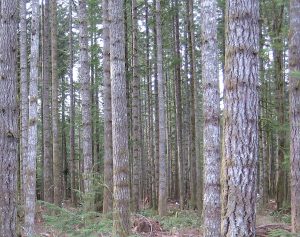
Like a deer racing through a forest of closely-spaced trees, he can be briefly glimpsed. And like a deer, my brother, at times, pauses in flight to peer back over his shoulder, gazing at me in recognition from between the trees. Sometimes, I see him clearly. But mostly, there are mere glimpses.
Just there, between the trees.
Johanna Skelly is a Toronto-based painter, writer, and poet. She is a writing facilitator and copy editor who finds inspiration in all things written. After eighteen cross-Canada moves, she sees herself as a recovering nomad, and is happily discovering the art of putting down roots.

Third Place:
Who’ll Stop the Rain?
By Margaret Watson

Photo by: Ahmed Photography
I pull alongside the curb and nestle into the car in front of me. “Let’s sit here for a few minutes,” I say to my son. “See if the rain doesn’t let up.”
“Sure,” Brandon says.
It’s sullen agreement, but I’ll take it. I turn off the ignition and the windshield wipers come to a halt.
“You didn’t bring your clarinet. Don’t you have music today?”
“God. You already asked me that.”
Brandon undoes his seatbelt and twists around to reach his backpack from the seat behind. He roots around, looking for something. I watch but don’t ask if I can help. Damp curls escape from under his ball cap.
There is no rhythm to the rain, but I conjure lyrics and a gravelly, vintage voice and tap my fingers on the steering wheel in time with the song in my head.
Brandon finds whatever he was looking for. He zips his bag and leans back. Condensation rolls down the windows in rivulets. I can hear thunder but it’s not close.
“I should go. I’m going to be late and Ms. Morton already hates me.” He reaches for the door handle.
“She doesn’t hate you.”
“Yes, she does.”
“What makes you think so?” I vow, whatever he answers, not to disagree.
“She just does.” A shake of his head. “Oh, never mind.” His anger is an invading army, foreign, implacable.
Rain rushes in on the wind as he opens the door.
“I’ll see you after school tomorrow,” I say. “Behave yourself at your Dad’s.”
If Brandon says good-bye, his words are swallowed in the rolling thunder.
< >
A writer who lives in Toronto, Canada, Margaret Watson’s stories have been published or are forthcoming in paperplates, FreeFall, Hamilton Arts and Letters and The New Quarterly. She has been short and longlisted a number of times and recently won first prize in Streetlight Magazine’s 2022 Flash Fiction contest.
Honorable Mentions in alphabetical order by author:
Reham Adley for “Tante Sabahs Mouhalabiyeh”
and
Robert Marazas for “Stranger at the Mall”

