
“One of the best rewards of reading fiction, whether set in the present or the past, is to renew our faith in humanity, which we truly need at the present moment.” ~~H. Lee Barnes
People Write in Paragraphs and Speak in Sentences
 I thought I was done with WW II books until I read H. Lee Barnes’ Emerald City Blues. It’s set in Los Angeles instead of Europe, and it deals with the experiences of a young woman who leaves a sheltered life on a farm in Washington State and goes to work in a factory making boots for Marines. We follow her adventures and the fears and paranoia of a previous time. The story is timely today for reasons that will become obvious if you read the book.
In the Q&A below, the author answers questions about his process, his sources for stories, and university presses.
BLG: Tell us about your background and how you decided to become a writer.
HLB: I come from a lower middleclass family. I served in the Vietnam war and later became a cop, experiences that feed my writing. I returned to college at age thirty-nine and completed a bachelors and Master of Fine Arts degree, but my writing began before that when I wrote a novel (by longhand) based on a shooting I had been involved in as a narcotics agent. That effort was a failure in several ways, but I learned from it that I had the discipline to sit and write for hours and be creative with both language and scenes.
BLG: Do you remember how you first got the idea for Emerald City Blues? Did Eve or H.T. come to you first?
HLB: Eve came first along with the idea of writing a novel round women who worked in San Pedro. I picked “Eve” as the central character because in a way the name embodies all women. H.T. evolved into the story because it need a foil for Eve’s character and I am a fan of old blues singers such as Muddy Waters, Lighting Hopkins and, of course Rober Johson.
BLG: How did you pick your setting and how much research was involved in creating the time and place?
HLB: The setting picked me. In 2000 I visited San Pedro, where the harbor area spoke to me of life there during WWII and especially women’s roles in it. The WMCA set in the novel is still there and preserves its history.
BLG: You worked on Emerald City Blues for a long time. How did it evolve, change, and grow?
HLB: In many ways the novel evolved as the characters took shape on the page. Each scene, each interaction among or between them fed the narrative. I wanted their experiences to be credible but challenge them in ways that revealed both their spirit and their growth as people.
BLG: That sounds similar to a lot of my writing. What do you most want readers to take from the story?
HLB: Other than supporting an obscure writer’s work, my hope is that the story will affirm a belief in our better human character. One of the best rewards of reading fiction, whether set in the present or the past, is to renew our faith in humanity, which we truly need at the present moment.
BLG: I’ve always been curious about university presses. What advice can you offer us about finding a university press seeking memoir or fiction if you are not associated with the university? How are they different from commercial presses?
HLB: What writers should know is that the process of publishing with a university press can be tedious, but the writer is rewarded with a top quality book that will have a reasonably long life. A University Press is interested in literary writing, whereas Commercial presses, esp. the big 5, are not on the lookout for good writing so much as books with commercial appeal to targeted readerships. Big advances go to writers of popular fiction or to celebrity types. Modest advance go to other writers. Most university presses are marginally funded and can’t offer advances or invest heavily in advertising.
BLG: What’s the best writing tip you received from an editor or publisher you worked with?
HLB: I can’t think of one, but my stepfather’s mother (Grandma Ames) told me once when I was 13 and rambling on about nothing, “People write in paragraphs and speak in sentences,” which is wonderful advice to anyone, especially mindless self-centered talkers.
BLG: What are the advantages of working with a publicist and how do writers find a good one who won’t break the bank?
HLB: A publicist who believes in the book can break through the “attention fog.” Kim, my agent, reached out to venues I have never heard of and brought some interesting attention to the novel. The expense for an obscure writer like me can be weighty, but worth it.
BLG: What are you working on now, and how can people learn more about you?
HLB: I’m working on an epic novel titled The Gambler’s Road. Set in the late 1920s to the ’50s, it follows Willy Bobbins from New Orleans to Texas, then to Montana and finally Las Vegas. In ways, while telling a rough-and-tumble story, it deconstructs the myth of the mob running all Las Vegas gambling.
BLG: The new book sounds as original as Emerald City Blues. A review of that book is at https://writeradvice.com/winter-2026-hooked-on-books/ and there’s a link to Amazon for the book there. Please keep sharing your wonderful stories and your unique POV.
@@@
“While such a story can sometimes be grasped in a flash of understanding, creating that flash piece can’t usually be done in a flash.” ~~Pamelyn Casto
Take It Apart to Find Out What Made It Work
An interview with Pamelyn Casto by B. Lynn Goodwin
Note from the Editor: Many of the principles behind both flash fiction and flash memoir are the same. This interview can help you shape and polish your story and if you’re entering either our flash memoir or fiction contest, it might help you improve your entry. You can read our review of Flash Fiction: Alive in the Flicker here. Scroll down.
BLG: Tell us a bit about your writing background and how you got so deeply involved in Flash Fiction.
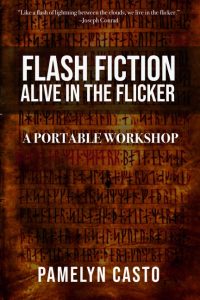 PC: Years ago, I fell in love with poetry and prose poetry, enjoyed and studied them both. Then I heard about flash fiction, and I’ve been hooked ever since. I ran some online flash fiction critique workshops, and then, around 1998, an editor asked me to write an essay on flash fiction. I got busy, did tons of research, and the essay proved to be quite popular—it was one of the earliest online essays on flash fiction. See it here. I’ve also taught online courses in flash fiction (and haibun). So, since day one, I’ve been heavily involved in flash literature. Enough, even, to write my book on the topic: Flash Fiction: Alive in the Flicker, A Portable Workshop. See it here.
BLG: On p. 62 you begin an insightful section called “Turn Your Anecdotes into Flash Fiction.” When a writer is editing her/his work, what are a couple of questions they should ask to determine if they’ve written flash or an anecdote?
PC: I’m proud to say my essay was originally published in Writer’s Digest. I think the main question would be, “Did I put my ‘I’ out?” Did I remove the personal “I” experience and replace it with a more carefully formed story with meaning? When we write a true story or tell a personal anecdote, we tend to stick to the facts of the situation. But when we switch to fiction, we’re no longer locked into the exact facts of what might have actually happened to us. In making the change, we can remove unnecessary information so that the result can be a sharper, more focused, and more meaningful piece of writing. The characters and situations can become more “alive” in the fictional story. In other words, changing a personal anecdote into fiction can endow experience with enhanced meaning, or a different sort of meaning.
BLG: Any idea what inspired the many exercises in the book and how long did it take you to accumulate this wonderful collection of them?
PC: As I mentioned earlier, I was a moderator for various online flash fiction critique groups for well over fifteen years. In fact, one of my online critique workshops focused solely on flash fiction exercises and prompts. Through these workshops, I created and gathered many that I include in my book. I also taught online flash fiction courses for about ten years, and for those, I provided them as well. I’ve been coming up with prompts and exercises since day one.
BLG: Which exercises in the book have been most productive for you as a writer and teacher?
PC: I love experimenting with and retelling ancient myths. I’m working on a collection of the flash fiction and prose poem myths I’ve created or retold over the years, and hope to market that collection soon. I also enjoy exploring and experimenting with points of view. For an example of one of my recent points of view explorations, see my story “SOS, Someone Said” here. I’m presently exploring the five moods or modes of English grammar: interrogative, subjective, imperative, indicative, and exclamatory, and how these modes or moods also apply to flash fiction. For my most recent exploration of modes, see my analysis of Franz Kafka’s “Up in the Gallery” here
BLG: How does a writer know what to include in flash fiction and what to leave out to create a sense of mystery or open-endedness?
PC: That’s tough to answer. I think it comes mostly from closely studying good flash fiction. When I find a piece that’s outstanding, I take it apart to try to find what made it exceptional. I explore and study the piece to see what I might learn from it. From exploring stories in this way, a writer can develop a much sharper sense of what to include and what to leave out. Plus, a lot also depends on whether the story leans toward mainstream or literary fiction
BLG: What can those who write genre fiction, creative, or academic work learn from your book?
PC: I think most can learn from my book. It includes information on several anthologies of flash fiction and anthologies of flash creative nonfiction, and it contains tips on effective writing from the various editors of those anthologies. Plus, I include links to various outstanding flash literature pieces. Academics will likely appreciate my extensive history of flash literature.
BLG: What are some of the best places to publish flash fiction and flash non-fiction?
PC: My book contains several market recommendations. My Flash Fiction Flash Newsletter provides many more—markets that pay, that don’t pay, flash literature contests, deadlines, and more. It’s free, published every other month, and distributed via email. To subscribe, just send a blank subject header email to FlashFictionFlash+Subscribe@groups.io (be sure to include the plus sign before “subscribe” in the address). Or go here and follow the instructions. You’ll find great markets in both my book and my newsletter.
BLG: Where can we find samples of your favorite flashes?
PC: I am Senior Associate Editor at OPEN: Journal of Arts & Letters, where I do a series of essays called “A Close Reading.” This series contains analyses of some of my favorite flash fiction and prose poetry pieces. In that series, I explore what makes each piece stand out. You can see those essays here.
In addition, I’ve interviewed several flash fiction and prose poetry editors and writers through O:JA&L’s “Masters Series.” This free, online series of chapbooks includes my interviews, along with sample stories and craft essays from the featured writers. The featured writers thus far are Maxine Chernoff, Michael Martone, Peter Conners, Ray Gonzalez, Roberta Allen, Brian Clements, Pedro Ponce, and Mark Budman. Soon to be featured in the series are Tom Hazuka and Bruce Holland Rogers. Any writer can learn a lot from reading the chapbooks in this in-depth series. See that work here.
BLG: What else would you like readers to know and where can we learn more about you?
PC: Mainly, I’d like readers and writers to know that writing flash fiction isn’t easy. While such a story can sometimes be grasped in a flash of understanding, creating that flash piece can’t usually be done in a flash. It’s worthwhile to study the various types of flash fiction in order to be equipped with the strongest possibilities for our own work.
BLG: Thank you so much for sharing your wisdom with us. I’m still enjoying the exercises in your book.
You can learn more about flash fiction expert Pamelyn Casto at https://pamelyncasto.weebly.com

