
“…cultivate equanimity, dig deeper, and resist bad advice.” ~~Joan Silber
Mercy ~~How a Good Author Shapes It
An Interview with Joan Silber by B. Lynn Goodwin
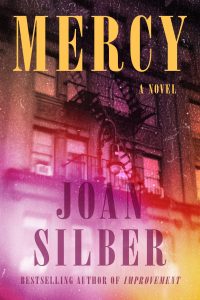 Critically acclaimed Joan Silber is an insightful writer who specializes in connected short stories. Her latest collection, Mercy, takes readers to Greenwich Village in the 1970s where Eddie, his girlfriend Ivy, and Ivan hang out. Ivan takes Eddie to the emergency room after a heroin overdose, but leaves him there alone. For the rest of his life he wonders how he could leave him alone to die or whether he actually survived. Ginger rises in the TV world while Ivan flounders.
There are other characters with other consequences in their lives, and the interconnected stories remind me of the concept behind Six Degrees of Separation. The author received The National Book Critics Circle Award for Fiction and the PEN/Faulkner Award.
She drills into the complex lives of her characters, showing everything from character flaws to hope to the growth that most caring human beings want to achieve. In our Q and A below she tells her story and shares her sources of inspiration.
~~~
BLG: Tell us a bit about yourself. When did you know you were a writer and when/where were you first published?
JS: I wanted to be a writer from a fairly young age—I was always a very intense and constant reader. My first story was published (sometime around 1970) in a feminist literary magazine called Aphra. (I also had a nonfiction piece in a magazine called Off Our Backs—you get the idea.) My big break came in 1974 when Redbook, a popular women’s magazine that published good fiction, took a story. I was in the same issue as a condensed form of Toni Morrison’s Sula!
BLG: Did the story start with Ivan, with Eddie, or somewhere else? What inspired it?
JS: I’ve lived my whole adult life in the city of New York, and I’d long heard stories of drug users being abandoned by friends in emergency rooms. My idea was to use the character who would later have regrets, so I began with Ivan, stunned and terrified by his friend’s overdose, who sees a way out he can’t resist. I like covering long stretches of time and I knew I’d be interested in inventing a whole life for Ivan, seeing how he turned out.
BLG: How did you develop the mood in these stories?
JS: I knew my characters were tough but not that tough. Ivan and Eddie, who begin the novel, are middle-class guys getting in over their heads. But I didn’t want this to be too simple or moralistic—I worked hard at getting Ivan’s internal voice, the excuses he makes, the illusions he sees through, even at the time.
BLG: What points about the ways we interact do you hope readers will take away from Mercy?
JS: My wonderful editor said, when we were working on the book, that he didn’t think anyone could get to a certain age without having remorse about something. And I wanted to go beyond that, to go further, for readers to see the workings of mercy and its necessity. The ending chapter, which I hope is something of a surprise, is also meant as a sort of lift-off, a widened view.
BLG: How did you find your agent and why do you like about working with Counterpoint Press?
JS: I found my agent through a writer friend. I’ve loved working with Counterpoint—my last three books (I’ve published ten) have been with them. I feel understood by them, and I feel they are genuinely working in my interest.
BLG: What do you teach and how does teaching help your writing?
JS: I actually stopped teaching six years ago, but I loved it when I did it. I taught fiction writing to undergrads and to MFA students. I think what I learned most usefully was to deduce the shape of a story—how it was building, where it could go. And as I got better as a teacher, I learned to focus on what a student was doing best, and to advise the student about furthering that. I stopped seeing teaching as a matter of correction.
BLG: What advice do you have for writers trying to get published in 2026?
JS: I used to always tell students, as my parting words—cultivate equanimity, dig deeper, and resist bad advice. This is still valid. Trends change—domestic realism was considered the major form when I was starting out, and we certainly give more respect to speculative fiction and to formal inventiveness now. Writers have to follow their own lights—the process is to discover what these are. What can you do that no one else can?
BLG: Did your publisher or agent apply for your many awards or did you? How have the awards helped your career?
JS: My publishers applied for the awards. These have made a huge difference—the work is given more attention by both reviewers and readers, taken more seriously. The last six books are written in a form I made up—they divide into stories that spin out in different directions—sometimes a minor character in one is major in the next–and build to an end. Because of the awards, people see that I’m doing that on purpose, not trying to write a more conventional novel.
BLG: What else would you like the readers of this interview to know and where can they learn more about you?
JS: I’ve had a long, zig-zagging career—my first book did well (won the PEN/Hemingway Award), my second book (which has just been re-issued) met with a more underwhelmed response, and I had a spell of thirteen years when I couldn’t get a book published.
During that bleak time I did think of giving up writing, but that was like saying, I’m going to go eat worms. I did other things in the world—I developed an interest in Buddhism, I was a volunteer for Gay Men’s Health Crisis (this was the 90s). And I think those things helped the work, when I did emerge.
Readers can see more on joansilber.net.
BLG: Thank you so much for sharing your thoughts and insights. You’ve had an interesting and varied career, and I hope you keep finding new followers like me.
Ms. Silber encourages you to find the work that only you can do. So do I. When you do so, you’ll become a voice that provides insight to readers. And get yourself a copy of Mercy, which is available in bookstores and online.


Leave a Reply