
“…the narrative ended up going off the rails, taking on a life of its own, becoming less and less about me and much more about the questions I was asking….” ~~Haili Blassingame
Modern Love Essay Opens Doors
An interview with Haili Blassingame
I was delighted by WOW—Women on Writing’s offer of an interview with Haili Blassingame, whose writing career is off to a great start. She shares some wonderful insights and opinions in the interview below.
 BLG: Tell us a bit about your writing background. What made you decide to write a romance for the 21st century?
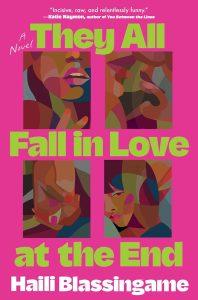
HB: I’m that person who’s been writing since I can remember. I’m also that person who has, my whole life, been an abiding steward and consumer of love stories. And I should say right now that, THEY ALL N FALL IN LOVE AT THE END isn’t a romance. (don’t be tricked by the hot-pink cover and, well, the people calling it a romance!!). This isn’t me being persnickety either! (great word by the way). ‘Romance’ is a genre with clear conventions—the A plot must be the love story, there must be a happily ever after or happy-for-now.
Usually there are beats to follow. A love story transcends genre. The center of gravity is a romance but that’s about the only rule to it. Ironically, an industry built on words has some limiting language when it comes to categorizing work. But anyway, to answer your question, I’m constantly courting the electricity I felt watching or reading about love at a young age.
Love is the organizing principle of my life, and I think my preoccupation with romantic love in my writing is a kind of bizarre attempt at manifestation; I’m still looking for that kind of love in my own life. If I can’t have it, I’ll write about it then.
BLG: Where did you develop the writing skills that got your work picked up by “Modern Love” and how did you become a producer at NPR? How has the producer’s job influenced your writing?
HB: That Modern Love piece was one of those ridiculous rush-job things I wrote in a week because I needed the money. I can typically write essays quickly for some reason, though at that point I might’ve taken about one nonfiction workshop ever.
As far as my foray into radio goes, I interned at NPR throughout college as part of this incredible fellowship program called the Emma Bowen Foundation. And then, when I graduated from college, I taught 3rd grade for five seconds, was unemployed for a year, and then interned at 1A at my local NPR station.
Seven years later…the rest is history. We’re a daily news program in Washington, DC, so the anxiety of that job during the start of the second Trump administration, I mean just the sheer clip at which things unfolded, completely bled into the book. Some readers have said to me, “God, it was just too much, too soon for me,” and I bite my tongue, but what I want to say is, “Try having lived in the nation’s capital. You would’ve had no choice.” But of course I’ll keep that between you and me 🙂
BLG: Was THEY ALL FALL IN LOVE IN THE END inspired by your life, your observations, or something else?
HB: I was absolutely searching for a story that would explain myself and my desires to me (why did I want three boyfriends? etc.) and realized I was going to have to write it. Of course, the narrative ended up going off the rails, taking on a life of its own, becoming less and less about me and much more about the questions I was asking, the confusion I was experiencing. That energy is still in the book, even though the events of it now dramatically depart from my life.
BLG: In your experience are characters or plotlines more important in carrying a story forward? Why?
HB: Can I disagree with the question’s premise? (Is that allowed???). Editor’s Note: Of course it’s allowed.
In short: I’d never choose between characters or plot!! You’ll often hear that a story is plot-driven or character-driven and, what does that even mean? (I mean, I get what people are attempting to telegraph in that distinction but it’s nonsensical to me). A character or characters are acting and those actions funnel into the plot. They’re inseparable. What is plot without the people at the heart of it?
BLG: I like your response, and of course character’s wants and needs drive the plot.
Conflicts and complications jump out of the story. How did you find and develop them? Do you have any idea how many you knew about before you started drafting? Any tips for propelling a story forward with conflicts?
HB: I found and developed them by ripping my hair out and crying on the phone to my mom. I do not outline at the outset which means I have zero clue how things are going to go down. This also means I tend to do a lot of revising and rewriting. The greatest challenge BY FAR was figuring out how to revise this book. I’d never done that before. I thought revision meant switching sentences around, so it was truly a paradigm shift, understanding that revision is, in some ways, when the real work of becoming an author begins. The greatest tip I learned from taking literary agent Cece Lyra’s class on tension, stakes and conflict. Know the difference between those things and you’ll be golden plotwise.
BLG: How did you find your agent, what clicked between the two of you, and how long did it take for her to find your excellent publisher?
HB: My story is annoying in that my agent reached out to me based on my Modern Love essay, we had a phone call, and then she signed me. Even more annoying than that is, when we went on submission to editors, we had interest from my current editor the next day and a deal the next week. But don’t worry! Judging on how things are going with my debut right now, looks like my luck has run out—lol.
BLG: Book publicity has changed radically. How is Scribner helping you publicize the book, and how much are you doing on your own?
HB: They’ve moved mountains; it’s incredible. My publicist Clare is a queen, and my marketing person Lauren is amazing. They’ve done more than I could’ve ever imagined. I’m lucky, lucky, lucky to be a Scribner girl. I’ve done a lot too. I can be very scrappy and bullish. But, for example, there is no way I could’ve gotten myself a review in The New York Times or a shoutout in The New Yorker. Just no way. They did that with their magic fairy wands. I’ve got some angels looking down on me in New York, that’s for sure.
BLG: What has been the best part of your career so far? Why?
HB: Oh God! I think the NYTs book review was, of course, huge. It was the only rave review I got after a bunch of mixed ones from the trades that made me want to expletive expletive. I love the smaller stuff too: being a staff pick at an indie bookstore or at a library. I was Mallory Melton’s staff pick at Book People in Austin and a staff pick at Chicago Public Library. That’s so cool to me, just people’s immense generosity. And readers, too, make all the humiliation worth it. Someone on Substack said that my book made them want to make mistakes, kiss the wrong people, that it made them want to live. I think I cried reading that.
BLG: What else would you like us to know, what are you working on now, and where can people learn more about you?
HB: This book is a messy love triangle story and a challenging family drama. It’s riotously funny at times and it will force you to sit inside several big questions about love and autonomy and what we owe ourselves when that debt is in direct conflict with what we owe those we care about. It’s more political than you’re anticipating and that’s on purpose. It’s literary and plotty and fast-paced. There’s spice and softness. So: expect ‘too much.’ Expect everything. Or better yet, discard your expectations entirely.
Releasing a debut into the world is a scary, anxious experience so if you’ve read this far and end up buying a copy of my book, please know it means everything to me. I’m always (unfortunately) working on something. I’m revising a literary time travel novel that’s part domestic drama, part second-chance romance with some light horror. It’s like Sally Rooney meets 17 Again (pray it gets published!!!).
You can find me on Substack at Touch Her & Die! And on Instagram @hailiwroteabook. My website’s weird but it exists. Hailiblassingame.com. It looks crazy on your phone, just so you know.
@@@
“That [idea] came from a classic “What if?” ~~Ann Bancroft
A Journalist Tries Fiction and Wins an Award
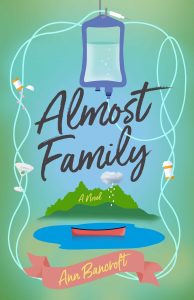 There’s nothing like cancer to alter a person’s outlook on life. But what if you don’t want to talk about your own experiences? Ann Bancroft shows us how to make a real life experience a springboard for fiction as she talks about creating Almost Family: A Novel.
If you’ve had a manuscript sitting in a drawer for years, there’s advice about that too in the interview below. Please keep reading.
BLG: Tell us about your writing background and how your career in journalism helped or hindered you as you wrote this novel.
AB: For more than 20 years, I worked for newspapers, wire services and, occasionally, magazines. The daily discipline required for those jobs really helped me with the first essentials in writing a novel – starting, focusing and sticking to it.
The scope of a novel was hard for me. My years-long reporter’s habit of summarizing and leaving out descriptive details got in the way of opening up my writing, slowing the pace and widening the lens of my story. But journalism gave me practice in close listening, capturing essential dialogue, observing, and editing. It wasn’t too hard for me to be a ruthless editor of my own work, “killing my darlings,” as they say, to keep the story tighter and on track.
For about a year I had the privilege of working as an editorial writer at the Sacramento Bee. That gave me the opportunity to learn how to write with an opinion, and to put more of my own voice into my work.
BLG: I’m fascinated by the relationships in this book. What do you hope readers will learn about friendship? About support? About mothers and daughters?
AB: I hoped to show how deep friendships can be formed despite differences in culture, religion, sexual orientation and backgrounds. My characters bonded over profound shared experiences — they all faced terminal diagnoses, and later learned they shared similar, painful family issues — but it wasn’t those difficulties that created the friendships. It was their commitment to one another, and to opening up in an authentic way.
Protagonist Liz is a mother who doesn’t know how to talk to her daughter until she learns how to understand the ways in which her ex-husband’s alcoholism affected them both, leading to near-estrangement. With the support of her new friends Dave and Rhonda, she learns to open up honestly to her daughter, not always successfully but in a way that ultimately heals them both.
BLG: How did your experiences battling cancer inspire you? How much did you borrow from your own experiences?
AB: After my first bout of cancer, which took about a year of treatments and recovery from treatments, I really was sick of it all and did not want to write about cancer, particularly not my own. But there were so many things I saw and felt during that year it was hard to not write about them. Facing mortality, for example, and the unexpected gifts that come with that. The often odd, sometimes funny ways people react when one has cancer. Most significantly, I wanted to show the ways in which cancer doesn’t change you. It doesn’t turn you into a saint or a sage, it doesn’t confer bravery or heroism, it doesn’t remove all pettiness, jealousy, awkwardness or fear. It does provide some extreme experiences that can alter one’s worldview, open one up emotionally, and enhance empathy.
My experience as a mentor to breast cancer patients really did the most to inspire this novel. I befriended women whose responses to their cancer were different from my own, and who came from backgrounds different from my own in just about every way. That was the germ of the idea of having people bond in a support group for Stage Four cancer patients.
Why Stage Four? That came from the classic question that’s so helpful in writing fiction: “What if?” I had been very fortunate during my first year of cancer. Though aggressive, my cancer had not metastasized. I had a good job with excellent health insurance and tremendously supportive colleagues, family and friends. My husband was there all the way. But what if none of those things had been true? What if I’d been alone, having just gone through divorce and then a terrible breakup, and had been diagnosed with Stage Four instead of Stage One? That’s how my main character, Liz, was born.
BLG: Tell us about your writing process for this book. How did you plot, plan, and pace this story and when did you let the story emerge and wait to edit later? What was the most useful feedback you received?
AB: I began this novel because I wanted to learn how to write fiction. I joined writers’ groups, took classes, and wrote a couple of terrible drafts. I am not a good plotter or planner. I’m more of a “pantser,” and the story often emerges as I’m writing. I’ve had so many years of editing as I write, it’s hard for me to get through many pages without editing, but eventually I wrote for some long spurts without rewriting along the way.
I had a couple of chapters and some scenes in mind, and the story developed from there. I found a teacher who helped to keep me accountable, and made myself sit down and write every morning – at least two hours or 750 words (a small enough goal to reliably reach). I would read it aloud to him, some ten pages at a time. He never sent edits, just said, “stop there” and asked questions. That way I could hear what was missing or flat or (so often!) written like a newspaper story. He (the late Tom Spanbauer, to whom I dedicated the book) offered the greatest feedback, because I was required to listen, see, think about and fix it myself.
BLG: We’ve both been members of Amherst Writers and Artists groups. I found them to be wonderfully encouraging. How did they contribute to your ability to craft scenes and tell the story that you wanted to tell?
AB: The AWA method of writing to prompts for short periods of time is tremendously freeing and helped me trust my own creativity and strengthen my writing voice. I found the process so satisfying I became certified to lead AWA groups and have done so for more than a decade.
BLG: How did you find your publisher? Did they encourage you to apply for the Sarton Award or did you do that on your own?
AB: Long story. When I reached “the end” in my writing, my teacher urged me to send the draft to three agents. I hadn’t hired an editor or even sent it around to beta readers! Big mistake. What I really needed was a developmental editor to help me more tightly focus. But the biggest of the three agents accepted it, to my shock. I made some suggested fixes, getting the new draft back to the agent like a good journalist, far too quickly and again, without feedback. As a result, I received lovely rejections.
The book stayed in a drawer for four years, until I did some editing and it won Best Unpublished Novel in the San Diego Book Awards. Finally, during Covid and in the same year I had a recurrence of my breast cancer, I hired a developmental editor to read it over and write a couple of memos with suggestions for more revisions. I worked to make the plot tighter and the mother-daughter relationship more central to the story.
When “the end” was truly the end, at least of the writing, I decided to submit to a hybrid publisher, She Writes Press. It’s run by women for women authors, and provides a supportive community as well as good cover design, clean publication and distribution through Simon and Schuster. They provided a list of credible awards and reviewers, with Sarton high on the list, so I sent my book to Story Circle Network. So happy I did!
BLG: What did it feel like to learn that you were a winner?
AB: I was thrilled. It was tremendously validating to have my book chosen.
BLG: What advice do you have for non-fiction writers who want to try fiction?
AB: Take some classes, read books on the craft of writing fiction, do creative writing exercises (AWA workshops are great for this). Get comfortable with writing as if you are talking to a friend.
BLG: What else would you like us to know and where can readers learn more about you?
AB: I have a website, annbancroftauthor.com, and an Ann Bancroft Author Facebook page, though I don’t update either as often as I should. I can be reached by email at annbancroftauthor@gmail.com.
BLG: Thanks so much for sharing your thoughts and ideas with us. If you have a story inside of you, and who doesn’t, get the first draft done and then start your revisions. Accept the advice you agree with. Most importantly, share your story with the world.

