
Book Launches for Mobility-Impaired Authors
By Nikki Finlay
 “You can’t do it all.”
One of my book coaches said this to us about book launches. We all have time and energy constraints. I also have physical limitations.
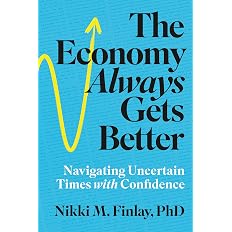
Even if I wanted an impressive launch schedule for my forthcoming book, The Economy Always Gets Better: Navigating Turbulent Times with Confidence, I couldn’t manage it.
I only have so much energy, and there are bookstores and libraries that I can’t get into.
So, since Writer Advice is my first stop on the WOW book tour, I’ll share the system I set up:
- Select a sales target.
- Do what you can.
- Get in front of people who can help.
- Find what works.
- Give yourself grace if things go awry.
- Repeat for the next five to ten years.
You need to have a sales goal in mind. You want your launch phase to go well, but selling books regularly over time is what counts. You can quit marketing after launch.
For example, I haven’t visited any libraries yet. I’m saving that for the next round of promotion. Because you can’t give up after the first three months.
In my case, there will be guest blog posts along with my Substack posts, a limited number of bookstore signings each month, book festivals when I can, and the occasional book or professional conference.
I also asked economics instructors throughout my state (GA) for opportunities to give a lesson via Zoom. I can handle a few Zoom calls a week, but every away-from-home appearance requires my husband’s time in addition to my own.
For example, I’ve signed up for the Decatur Book Festival’s street fair. Since the set-up times are early, I’ve booked a hotel room and reserved a table at a restaurant for the night before. To make the meal special, I’ve invited friends to join us.
The next two pieces of the system go together. Some experiences won’t go well. Some pieces of your promotional plan won’t fit what you can or are willing to do.
Give yourself some grace when part of the plan doesn’t work out the way you want it to. Or if you hate doing something.
For example, I’d planned to get in front of fellow economists on Substack. That part of the plan isn’t working. I’m not giving that piece up yet, but it’s going to have to wait.
Getting in front of other economists is something I’ll spend more time on after New Year’s Day.
After all, you can’t give up on your book!
@@@
After more than two decades teaching economics at Clayton State, Georgia State, and Gwinnett Technical College, Dr. Nikki Finlay realized something important: most people are not “bad at economics.” They were simply never taught in a way that felt clear, practical, or relevant to their everyday lives. She helps people understand the economy without feeling intimidated by it on Economics for the Rest of Us. Her debut book, The Economy Always Gets Better, is for sale on Amazon.
@@@
Using Theme as a Metaphor to Increase Publication Success
Wendy K. Mages
 When I first began submitting my literary pieces for publication, it was hit or miss. To be honest, it was a lot less hit and a lot more miss. I had no clue how to identify appropriate journals for my fiction, creative nonfiction, and poetry. Moreover, I found the standard advice, “Read the journal’s last few issues,” extremely time consuming and not particularly effective. To make matters worse, I was erroneously attempting to apply the rules of academic publishing (which I had successfully followed for almost two decades) to the world of literary publishing. Wrong!
I soon learned that, unlike academic journals, many (if not most) literary journals allow simultaneous submissions. Submitting the same piece to multiple journals simultaneously offers a huge time-saving advantage. This may be especially valuable if the piece you’re submitting is time-sensitive or appropriate to a particular time of year (e.g., a holiday-focused story), as more reviewers will be able to read your work and (potentially) select it for publication during the relevant timeframe. To support my new “simultaneous submission” practice, I learned to use Submittable[1] to track all my submissions, as well as to identify journals currently accepting work, the type of work they were seeking, and the deadline for submitting. This proved to be extremely beneficial!
That said, when I began using theme as metaphor, it was a game-changer. I remember a workshop leader who suggested subscribing to Duotrope’s[2] weekly newsletter. There’s a free trial period and, as someone who loves a freebee, I signed up. When the first newsletter arrived, I noticed it contained a list entitled, “Upcoming Themed Deadlines.” I perused the list of themes and began using this weekly list to guide my submissions.
At first, I used the themes quite literally. When I saw that Quibble Lit[3] had posted a call for submissions focused on “Trouble,” I submitted, “Mirror, Mirror,”[4] a story on early signs of trouble in a relationship. I was thrilled when I learned my piece was accepted!
I quickly realized that using themes to guide submissions helps in two ways. First, it provides a clear frame for both you (the writer) and the reviewers, in which adhering to the theme is a criterion for selection. This makes it easier for you to know if the piece you’re submitting is “appropriate” or is “what they’re looking for.” Second, it’s possible that the thematic frame reduces the total number of submissions. In other words, a more targeted submission call may limit the number of works submitted and, thus, boost your submission’s chance for inclusion.
I soon discovered that using themes (even in a literal way) to guide my submissions was boosting my acceptance rate. So, I began experimenting. I took risks with my submissions, using the themes as metaphors. For example, when I saw that 3cents Magazine was preparing for a themed issue on “Slipping,” I submitted “Before the Last Snow Melts,”[5] a nonfiction narrative about a woman at the end of life whose husband has Alzheimer’s. No one literally slips or is slippingin this story. So, in the cover letter I noted that the story was about a woman and her husband who “are both slipping away, one in body, the other in mind.” I was honored to learn my piece would be included among the three pieces selected for this issue.
“So,” you might ask, “does using theme as metaphor make a real difference?” I believe it does. A theme can unify diverse works of fiction, nonfiction, and poetry. Yet, no editor wants an issue to seem monotone, bland, or redundant. Using theme as metaphor means the piece you submit will likely stand out among all of the other pieces that relied on a more literal interpretation of the theme. Thus, your piece will likely add an additional note, flavor, or perspective to the collection of submissions. This gives your piece a bit of an edge as the editors consider which pieces make a valuable contribution to the theme and to the issue. Using theme as metaphor helped me improve my acceptance rate, and I believe it can work for you, too. Try using theme as metaphor for the next 6–12 months to discover if this strategy can help increase the number of your pieces accepted for publication.
Author Bio
Wendy K. Mages, a Mercy University Professor, is a Pushcart Prize nominee and an award-winning poet and author. She earned her doctorate in Human Development and Psychology at the Harvard Graduate School of Education, her master’s in Theatre at Northwestern University, and her bachelor’s in Theater Arts at Brandeis University. As a complement to her writing and research, she performs at storytelling events and festivals in the US and abroad. To learn more about her and her work, and to find links to her published stories and poetry, please visit her Mercy University Faculty page https://www.mercy.edu/directory/wendy-mages and her website, Wendy Mages: Storyteller https://sites.google.com/view/wendy-mages-storyteller
Wendy’s Social Media:
- Instagram: @WendyMages_Storyteller
- Threads: @WendyMages_Storyteller
- BlueSky: @wendymages.bsky.social
- LinkedIn: www.linkedin.com/in/wendy-mages
- [1] Submittable https://www.submittable.com
- [2] Duotrope https://duotrope.com
- [3] Quibble Lit https://www.quibblelit.com
- [4] Mages, W. K. (2022). Mirror, Mirror. Quibble Lit. https://www.quibblelit.com/mirror-mirror-by-wendy-k-mages
- [5] Mages, W. K. (2023). Before the Last Snow Melts. 3cents Magazine, (5). https://www.3centsmagazine.com/issues/slipping/before-the-last-snow-melts
@@@
Suzanne Roberts Book Promotion Tips
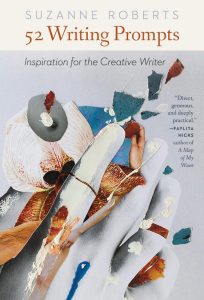 Dr. Suzanne Roberts is the author of 52 Writing Prompts: Inspiration for the Creative Writer, coming in October from the University of Nebraska Press. She sent this e-mail to those on her mailing list. It’s a great model for what you might do to promote your book.
She is also the author of Animal Bodies: On Death, Desire, and Other Difficulties (Nebraska, 2022), longlisted for the 2023 PEN/Diamonstein-Spielvogel Award; Bad Tourist: Misadventures in Love and Travel (Nebraska 2020); and Almost Somewhere: Twenty-Eight Days on the John Muir Trail (Bison Books, 2012), winner of the 2012 National Outdoor Book Award; as well as four collections of poetry. Visit her website at www.suzanneroberts.net. Or visit her on Substack at https://suzanneroberts.substack.com.
Need some prompts to pull you out of a slump or stimulate your creativity? Buy her book and use it or visit the Writing Advice page and use our prompts. Need variety? Use both.
Here’s the e-mail with our thanks to Ms. Roberts, who believes there’s no such thing as writer’s block.
Dear Friends,
I always feel sheepish writing the “book announcement” email, but at the same time, if I don’t do it, you might not know I have a new book that’s now available for preorder. 52 Writing Prompts: Inspiration for the Creative Writer is a book for anyone who wants to get words down on the page. The book is different from many other creative writing craft books in that it takes a multi-genre, themed approach with readings from contemporary writers. Most of the themed 20-minute writing prompts (there are 77 total, counting the bonus prompts) are based on poems, essays, and stories I’ve gathered from exciting contemporary writers, and all the featured writers have offered their own bit of writing advice. I created prompts that work in the three genres of fiction, essay/memoir, and poetry.
52 Writing Prompts makes a great gift for someone who would like to write a book or just needs a little creative inspiration. It’s accessible and informative, friendly and funny, smart and practical.
WAYS TO HELP
Preordering the book
One of the best things you can do to help authors succeed is to preorder their books. The number of preorders signals to the press that the book is worthy of marketing resources, which can make a huge difference in getting the word out. This is why I am writing this “Please preorder my book” email to you, even though it makes me cringe to do so.
My press is offering a special Friends & Family discount of 40% (the same as my author discount) to preorder the book. Use the discount code 6ROBERTS40, when checking out at the University of Nebraska Press website. Also, if you prefer, you can preorder from your favorite independent bookstore, or anywhere else books are sold, including that place that starts with an A, where it’s also available on Kindle. Unfortunately, the discount code won’t work anywhere but the University of Nebraska Press website.
Leaving a short review
Marking the book as “want to read” on Goodreads and leaving a review is helpful for getting the word out. And you don’t have to say much. You can just say, “Great book” or Useful for writers” or whatever. Once the book is out, you can also leave a review on Amazon and Barnes & Noble. And again, you don’t have to say much—a few words is fine. More 5-star reviews mean the book is more visible in the algorithm.
Asking your library to order it
An easy way to support me and my book is to ask your local library to order it. Many libraries have an online form for this. And also, many libraries host author events. Tell your library about me, and maybe I’ll get to come to your town and visit you!
Posting about it on social media and telling your friends
If you’re active on social media, posting a photo of the cover (I’m attaching it here, along with a info sheet the press made for me) or a photo of you with the book once it arrives, is a great way to spread the word. Please tag me, so I can share your post!
Adopting it for your courses
This book is prefect for the multi-genre undergraduate creative writing course. I have also sent it to some of my MFA students, who tell me it’s super helpful to them as well. If you adopt it for your one of your courses, I’m happy to ZOOM in for a class visit! If you’re considering it for course adoption, please let me know, and I’ll have my press send you a digital advanced reader copy. Also, please tell your friends who are writers, readers, and teachers. I’m very much hoping to get this book into college classrooms.
Questions? Please ask and I’ll forward them to Dr. Roberts. Thanks!

