

Editor’s Note: The tools that engage the right attitude apply as much to marketing as to writing, so I decided to post this here. Clearing your mind matters.
Thank you, Sheri McGregor, for sharing your insights with us.
Clear Mental Clutter—and Write
By Sheri McGregor, M.A., author of
Rumination Remedies: A Workbook to Free Your Mind From Worry, Regret, and Racing Thoughts
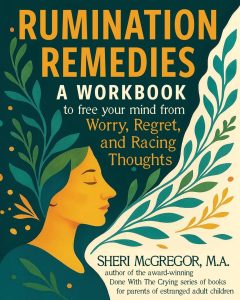 Writers may struggle with creative problems they frame in writerly terms: a lack of inspiration, a weak plot, or a stubborn scene. But sometimes, a writer’s “block” has more to do with mental clutter. For you, that might be things that need doing, background worry, or that appointment you still didn’t make. Those niggling thoughts compete for the focus your writing needs. If you don’t learn how to clear your mind, you’ll forever be chasing brain bunnies instead of writing. Over time, these mental dust bunnies drain away confidence and steal your momentum.
Don’t let your genius languish under the bed like a half-written novel. Your answer? Tidy up.
Make clearing mental clutter a practice
As a mother of five children, I learned early on that my writing time needed focus. There was always something or someone pulling at me. But a mind can only hold so much before attention starts to fragment. When that happens, writing feels like pulling elephants through keyholes. There’s just too much to fit—in this case more than your cognitive space can hold.
In Rumination Remedies, I talk about tidying up to settle into the present. When it comes to writing, presence is everything. Reducing background noise is the only way the work in front of you can come to life and have room to breathe. Make a practice of clearing mental clutter, to give your creative energy needed space.
One way is to name what tugs for your attention. As you get ready to write, make a pen-to-paper brain dump a getting-started ritual. By naming tasks that need doing or what you must not forget, you deflate the emotional drag of them. More reasoned areas of the brain take over. If you write things down, you keep them safe. You can then relax, letting the to- or must-dos go for the moment—because you know they won’t be lost. Once done with your writing session, your list will be there to tackle.
For me, clearing mental space allows creativity to flow. You’re no longer fighting with your thoughts. You’re making a separate room for them. Clearing mental clutter supports discipline.
From Mental Clarity to Creative Momentum
Early in my writing career, I heard others say the only way to get past writers block is to push through. Because I always loved to write, that didn’t settle well with me. While it’s true you need a “work” routine for writing, I didn’t want to lose my joy. That meant finding different and better ways to frame the work elements. Part of that was learning how to work with myself and my brain, which—same as many writers—is always wandering.
In Rumination Remedies, I offer simple, neuroscience-based practices to help people identify mental loops, release unhelpful repetition or distraction, and restore clarity. While the book isn’t exclusively for writers, many writers find it especially helpful. Creating rituals, getting into flow states, and clearing mental clutter are among the techniques that aid creativity, promote focus, and increase productivity.
Learning to clear mental clutter can help you write more, with greater ease. Free your mind—the words will follow.
@@@
Here are some insider tips from Marketing with Koehler Books. They’re the company that published two of my books, Talent, and Never Too Late: From Wannabe to Wife at 62.
WISE ADVICE FROM KOEHLER BOOKS WITH NOTES FROM WRITER ADVICE
KOEHLER BOOKS shares ideas for marketing that include using social media platforms, offering a monthly email newsletter, blogging and more. Quotations from Marketing with Koehler Books are in black. The editor’s notes come from B. Lynn Goodwin. If a link doesn’t work, please let us know.
Each month, we feature our latest releases in a roundup post, and every book also receives its own dedicated post. We love celebrating our authors, so don’t forget to tag us in your own posts—we’re always happy to reshare your content and help amplify your message.
You can share your posts with individuals and organizations. Tagging is an easy way to do it.
NEWSLETTER – The Böokshelf
The month your book launches, it will be featured in The Böokshelf, our monthly newsletter that reaches readers and writers. We encourage all of our authors to subscribe to our newsletter, aswell as share the link with their friends, family, and audience, so that they can follow along as well.
Editor’s Note: If your publishing company doesn’t have a newsletter, you can start your own. Substack is full of newsletters or you can do one that goes out to everyone on your mailing list.
Bonus Content & Extra Spotlights
 In addition to our standard promotions, we also create a rotating lineup of bonus content that highlights our authors in fun and meaningful ways. Participation in these features often depends on how active you are with your own marketing efforts—so the more you engage online, the more opportunities we’ll have to collaborate!
Editor’s Note: The more you post the more responses you’re likely to have. Warning: You are always free to employ someone to do this, but as buyers should beware.
Author Interviews
We conduct monthly author interviews that are shared on our website and in The Böokshelf. They’re a great way to dive deeper into our authors’ stories, processes, and publishing journeys.
Editor’s Note: You can see samples of Writer Advice Author Interviews by clicking on the link. While we can’t guarantee that we’ll interview you, it never hurts to ask. We like interviewing the authors of memoir, YA, women’s fiction, some mysteries and psychological thrillers and books with an interesting slant on life. @e’re also interested in interviewing editors, publicists, and other support people. Send an e-mail through the Contact Box at the bottom of the home page and tell us a bit about your story or services.
Guest Blog Posts
 Got insights to share about writing or publishing? We often invite authors to contribute guest blogs. If you’ve got an idea, let us know—we’re always open to collaboration!
Editor’s Note: We’ve published several that are writing and marketing tips by authors participating in the WOW blog tours. We want pieces that are original, helpful, and not published elsewhere. Suggested length is 350-500 words.
LinkedIn is where we share a mix of author news, interviews, and blog features. Tag us in your posts, and we’ll be glad to reshare them with our community.
Editor’s Note: You can post your own notices on LinkedIn. If you have something to give away–like a sample chapter, that will draw more readers to your page.
⎯
Wise Advice: The more we see you engaging with your audience, the more opportunities we’ll have to highlight your work in creative ways. Start by promoting your book in 50 words or less in the comments below.

