
We extend our enthusiastic and heartfelt congratulations to the 8 winners in WriterAdvice’s 2026 Flash Prose Contest.
We also applaud those who were short listed, and everyone with the courage to submit.
If you feel WriterAdvice is a good place to submit your work, please do. If you are a generous writer, please share this site with your friends.
As usual, we included tightly written and evocative pieces that dealt with many subjects and multiple issues.
You’ll see our reasoning below each entry, and a new winner will be posted each week.
Please continue submitting. There are lots of places seeking flashes and all kinds of writing.
Our next contest, which is not flash, is posted at https://writeradvice.com/latest-contest/.
The Winners, and the Days They Will Be Published:
10/01/26 Meg by Erik Johnson
10/06/25 Before Sunrise, He’s Your Son by Austrie Martinez
10/13/26 Home by Connie Pertuz-Meza
10/20/26 Letter to Laura by Bari Benjamin
10/27/26 Green Chilis by Irene A. Marquez
11/03/26 Second Coming by Susan Wadds
11/10/26 Bleu by Robert Robeson
11/17/26 788 by Sascha Ealey
@@@
Before Sunrise, He’s Your Son
By Austrie Martinez
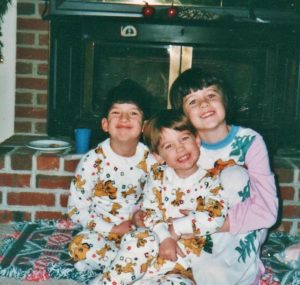 My dad never took pictures of us. My mom was always the one behind the camera. In one photo, that she took with her Canon, my brothers and I are posed by the fireplace at our home in Northern Virginia. The fireplace is adorned with holly and red Christmas ornaments that my mom probably personalized with puffy paint. On the brick mantle lies a plate with a half-eaten peanut butter and M&M cookie mom made from scratch, and perhaps, a small glass of milk. Both left for Santa and his reindeer when he visited our house the night before. My brothers and I are wearing matching Lion King pajamas that my mom surprised us with. Mine was a night gown and my brothers were thermals. This was the late 90s and the Disney movie had taken over our house with a fury. We were happy, loved.
What the picture doesn’t show is that the second born, my brother, is on the spectrum. His hyper fixation at the time, and for years, was learning about African animals. He had a big book about safaris that described how to pack a proper rucksack. We’d pretend to travel to Africa as we played in the basement with old costumes and cardboard boxes. He had Lion King toys from Burger King that we played with on the tall grassy hill in the backyard. Scar was hated and ended up with a scuffed paint job from all the fights with Mufasa. My brother had memorized the cassette tape version of Lion Kingthat my brothers listened to on their boom box every night as they fell asleep. With my door ajar, I listened from across the hall.
What you don’t see in the picture is the mural my mom painted in their bedroom with lion paw prints all over the walls. What you don’t see is the matching movie bedspreads she bought for the boys for their twin beds. What you don’t see is my mom buying Burger King repeatedly so we could have a complete set of Lion King toys. What you don’t see is my mom using a screwdriver to respool the VHS tape of Lion King after we watched it so many times we exhausted the cassette. What you don’t see is her making my brother’s zebra Halloween costume by hand and taking pictures of him while he pretends to eat grass. What you don’t see is my mom behind the camera. What you don’t see is my dad in the picture.
@@@
Austrie Martinez is an internationally published writer and a veteran of the US Air Force. She has an MFA in Creative Writing and Publishing Arts from the University of Baltimore. She teaches in Maryland where she lives with her two kids, two dogs, and two cats.
Editor’s Note: The author’s use of “What you don’t see…” and “What the picture doesn’t show…” make this particularly effective. Sometimes pictures don’t tell the whole story, and it’s the story behind the picture that interests us. The details also make this work. Well done!
@@@
Meg
By Erik Johnson
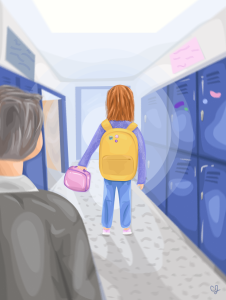 There, in the back row of the risers, among the tallest of the choir members, is Meg Glick, my daughter. Except she isn’t.
Janice Glick had approached me twelve years earlier with a desperate plea that her son, just completing kindergarten, be put in my class the following year to separate him from a bully. That exchange started an intense summertime friendship of innocent coffees, gossipy lunches, and one Aperol Spritz-infused afternoon dalliance at my place. I never got the impression her marriage to Robert Glick was unhappy, more like boring. As the cliché goes, we never meant to take it that far; it was a compounding of bad decisions. The friendship instantly dissolved in shame and regret. In the fall, her son was placed in my colleague’s class and I got the bully. No surprise there.
Almost six years later, Meg Glick showed up in my classroom. By that point, I had moved on, my moment of appallingly bad judgment largely behind me. The name “Glick” brought it all back in a flash of ink on a page, or rather, text on a screen. Meg had been placed in the other first-grade class, probably at Janice’s insistence, but we swapped for science, so I taught her three times a week. Something about her eyes had been familiar and intriguing. It wasn’t until I was shuffling boxes around at home and came across old family photos that I understood: Meg’s eyes were exact replicas of my mother’s and sister’s eyes when they were her age.
I couldn’t escape or ignore it. And then, this last year, as she entered sixth grade and hit puberty, her face transformed, the round cherubic visage becoming thinner, more elegant, more defined. Unmistakably like my sister’s teenage face, shades of mine as well.
I cannot hold back the feelings for this girl, becoming a teenager, becoming my daughter. Except not mine. It’s like an itch became an ache. I always figured Janice had not admitted our indiscretion to her husband. Should I blow that up, ruin a family, traumatize all involved, to attempt to have a relationship with my daughter?
Now, here we are, the day of the sixth-grade graduation. My daughter’s graduation. I struggle to hold back tears as I think about the next day, the next year, and all those to follow. She’s poised to leave my life forever. Oh sure, I was only ever her former (favorite) science teacher who still acknowledges her in the halls, the cafeteria, the playground. She’s always greeted me with a smile. And I’ve always gotten to admire her, laud her, venerate her. From afar, though. I hadn’t realized how much I’d come to depend on her proximity.
Until now. Because it’s ending.
As the choir’s final song reaches a crescendo, I wonder if I can steal a final word with Meg before she departs this school, my life. I chance a glance at Janice and her husband, standing among the teary-eyed parents at the back of the auditorium. Robert Glick is staring, not at Meg, but at me, eyes slicing into me like lasers.
@@@
Erik Johnson lives in New York and dabbles in flash and short fiction, poetry, novels, and screenplays. He has pieces in The Yard: Crime Blog, Half & One, Humans of the World, Wingless Dreamer, Free Spirit, Beyond Queer Words, and the Permanent Collection of Chateau D’Orquevaux International Artists and Writers. Artwork by Carly Johnson (IG: @carlymjohnson29)
Editor’s Note: There are lots of reasons to like this. We were particularly struck by the ending line and the narrator’s authentic turmoil which built throughout the pieces. His baggage helps readers appreciate the struggle.

